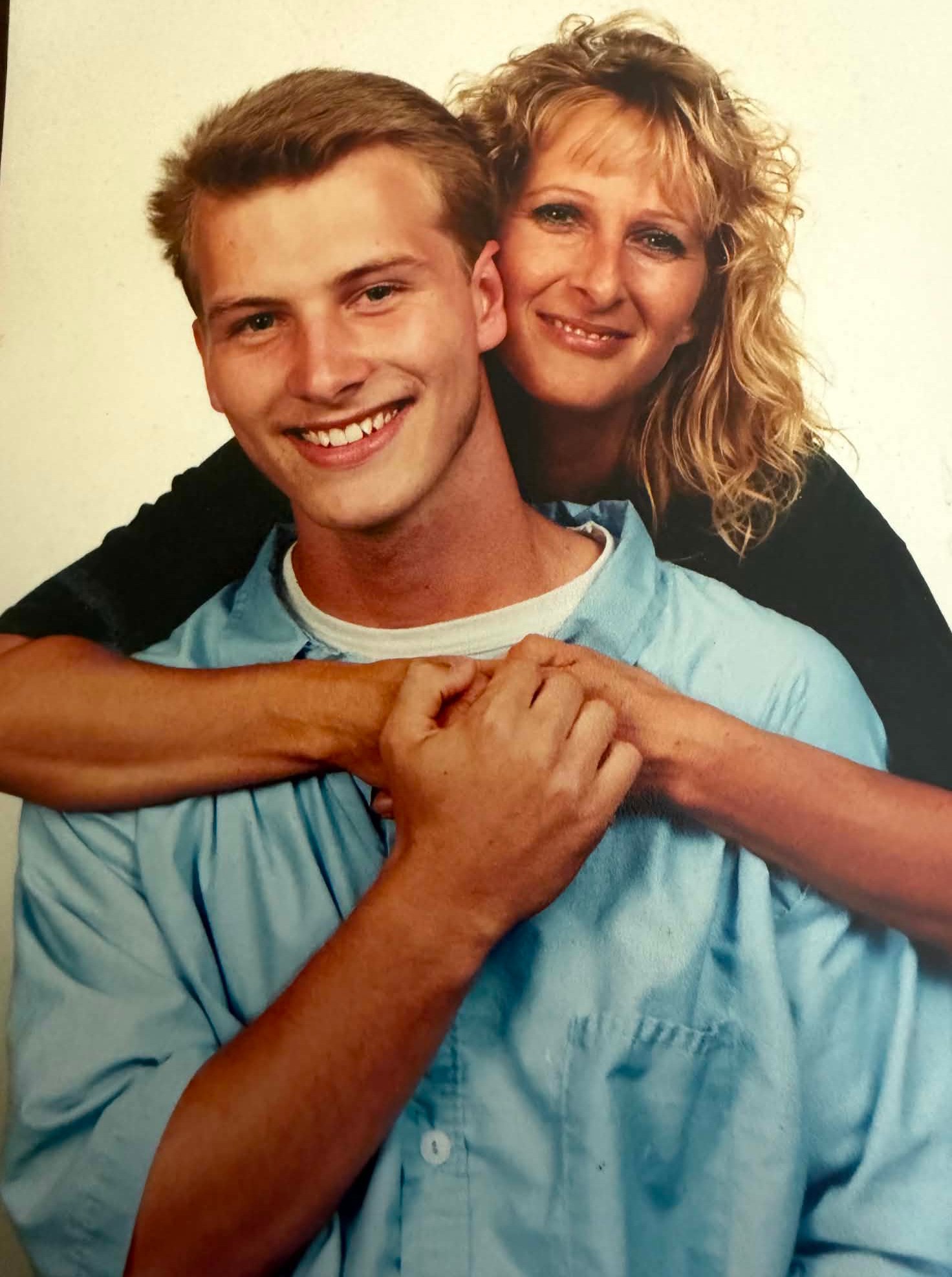
 Shawn and his mother Carla. Shawn was 19 and had just entered the Oklahoma prison system
Enid, Oklahoma
Published: May 24, 2026
Author: Injustice Spotlight Staff
Shawn Detwiler of Enid, Oklahoma, has been incarcerated in the Oklahoma Department of Corrections since 1998, spending nearly 30 years in prison for offenses tied to a series of crimes committed when he was a teenager.
Detwiler was 17 years old when he was arrested and charged in connection with the underlying offenses that led to convictions in 1997 and 1998. He was formally received into the Oklahoma prison system at age 19. Now 47 years old, he has spent more than half his life behind bars.
Court records show Detwiler acted alongside co-defendant Christopher Baldwin in the underlying offenses. Supporters of Detwiler have also raised concerns about Baldwin’s sentence and prosecution, arguing that both young men received extraordinarily severe punishment for crimes committed as teenagers.
Detwiler is serving a combination of consecutive sentences that include robbery with imitation firearm (46 years), robbery with a firearm (87 years), and a life sentence for shooting with intent to kill. Two victims were injured during the underlying incidents. While he has completed portions of his sentences, the remaining structure has left him facing what advocates describe as the functional equivalent of life without parole.
Advocates for Detwiler point to a 2019 post-conviction ruling in which two of five appellate judges dissented from the majority opinion denying relief. The dissenting judges concluded that Detwiler’s remaining consecutive sentences violated the Eighth Amendment, referencing U.S. Supreme Court precedent including Graham v. Florida and Miller v. Alabama, which limit the harshest punishments for juvenile offenders and require a meaningful opportunity for release.
One dissenting opinion, authored by Judge Lewis and joined by Justice Kuehn, stated that even under optimistic assumptions about parole eligibility and life expectancy, Detwiler’s chances of meaningful release were “slim and, more realistically, none.” The dissent further concluded that the sentencing structure effectively denies the meaningful opportunity for release required under evolving constitutional standards.
Detwiler later sought federal relief, but his petition was denied on procedural grounds his supporters argue prevented any review of the merits of his constitutional claims. Advocates describe those procedural barriers as “unduly harsh,” arguing they left no meaningful avenue for relief despite the presence of dissenting judicial opinions recognizing potential constitutional violations.
His incarceration has also been marked by significant mental health struggles, which his family says worsened after a 2009 assault in which he got into an physical altercation with another inmate. He was hospitalized and suffered a serious brain injury. According to family accounts, prison medical records, and advocates, Detwiler’s pre-existing mental health conditions deteriorated significantly after the attack.
Before the assault, Detwiler had earned his GED and participated in multiple educational and rehabilitative programs while incarcerated. His mother, Carla Detwiler, recalled that before his imprisonment he excelled academically in school, earning straight A’s and making the honor roll during his youth.
She said his educational progress and social behavior were noticeably stronger in his earlier years of incarceration.
Following the 2009 brain injury, his family reports a marked change in his mental health and daily functioning. In written correspondence, Carla Detwiler described a deterioration in his condition, stating that after the injury he began experiencing significant psychological distress.
She also described a change in behavior and personality, stating he became more withdrawn, less social, and increasingly isolated compared to his earlier years in prison. According to her account, he has struggled with substance use in an attempt to cope with these symptoms, which she believes has worsened his mental state.
Detwiler’s mother, Carla Detwiler, has remained a consistent advocate for his release. She said, “He was just a kid when all of this happened. I’ve watched him grow up inside prison walls, and I’ve also watched what that place has done to him. I just want him to have a chance to live what life he has left outside of those walls.”
An advocate with Injustice Spotlight said, “This case is exactly why executive clemency exists. When even appellate judges are divided and acknowledge constitutional concerns, continued incarceration becomes a question of mercy, not just punishment.”
Supporters for Detwiler are hopeful that Project Commutation will agree to take his case for review, citing its history of favorable outcomes in selected cases as a reason for optimism.
Supporters argue Detwiler’s case reflects broader concerns about juvenile sentencing practices from earlier decades, before modern constitutional standards emphasized rehabilitation and individualized consideration of youth.
Now approaching three decades in custody, Detwiler remains incarcerated despite documented programming participation, mental health deterioration following a traumatic prison assault, and judicial dissents questioning the constitutionality of his effective life sentence. For his family, the request remains the same: a commutation that would allow him a chance at release after a lifetime that began in prison as a teenager.